Interview with Dr Ramanathan Rajamani, Author of Pathigam Tales
An insightful conversation with Dr. Ramanathan Rajamani, author of Pathigam Tales, on resilience, spirituality, ancient Shaiva hymns, and their relevance today.on Sep 17, 2026
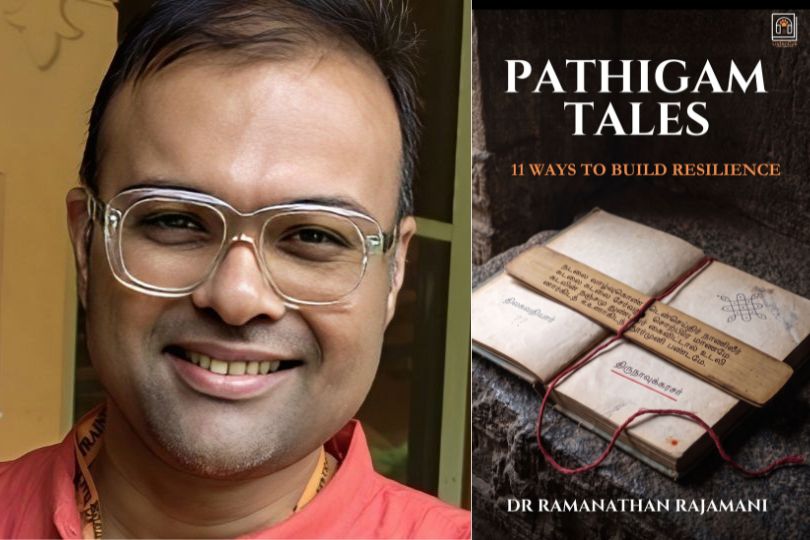
Frontlist: For readers who've never heard of "Pathigam" or the Thevaram, how would you describe what these hymns actually are, in one line?
Ramanathan: If you want the cocktail-party version: it's a hymn with a home address. Each pathigam is a poem with ten verses, one deity, one named temple. All pathigams were sung by men who fully expected to be heard, which is either enormous faith or enormous nerve, and after several years with these four I still haven't decided which.
Frontlist: Why resilience specifically, what about these ancient Shaiva hymns made you see them as a lens for that theme?
Ramanathan: Because none of these men were being resilient on purpose. Appar didn't kneel down and think, today I shall model healthy coping mechanisms. He got sealed in a kiln by a king. He had no say in the situation. People feel tenacity is displayed when there is a choice. When my mother-in-law had a stroke and we had to hold it together, I realised that continuing on the path of inevitability without losing one's core is also tenacity. Appar came out of a hot kiln having written about a cool evening by a river. That's not a strategy, that's just what was left of him once the fear burned off. I didn't go looking for a resilience book. In tough situations I kept going back to these hymns and kept asking what else have you got to give me, and resilience is just the word that kept showing up uninvited once I'd written them down.
Frontlist: How did you land on exactly 11 ways? Was it the structure of the hymns that led you there, or did you build the 11 yourself and find the hymns to match?
Ramanathan: Honestly, eleven is just how many survived the editing process. I would love to tell you it's numerologically significant, that eleven is the sacred number of something. It is really just the number of stories that stuck with me, the number of times a real hymn, a real place, and a real bad day for one of these four men all lined up cleanly enough that I could stand behind every sentence. A twelfth one didn't simply make the cut, the hymn's dating was shakier than I was comfortable putting my name behind, which I realise is a fairly unglamorous answer to a question that deserved a better one.
Frontlist: These hymns are centuries old, composed by saints in very different life circumstances. How did you translate their context into something a stressed-out modern reader can actually use?
Ramanathan: I mostly didn't translate anything. Where I come from, families make sure their children grow up with these sounds. Traditions that hard-worn still exist across the country, even the world, and sometimes I just feel how much of a blessing that is for our generation. It's like the Hanuman Chalisa in north India, the translations are already out there. But here is the part that's new. Every time you read the hymn, my experience is that the hymns speak to you differently, they give you a new relevance, a new meaning, depending on what you're actually going through. So I just refused to zoom out. The temptation with a seventh-century saint is to talk about him from a great height, the movement, the theology, the historical significance. The moment you get close enough to see that Sundarar is hungry and his wife is hungry and he's written a hymn that is, structurally, a grocery list, the distance collapses on its own. Nobody needs help relating to a man too proud to ask his in-law for money. That part hasn't changed in thirteen centuries and I doubt it ever will.
Frontlist: Is there one particular pathigam among the 11 that had the deepest personal effect on you?
Ramanathan: The hoe chapter, without question. Appar somehow reminds me of my own grandfather, and every other grandfather. My own grandfather kept a Pirandai plant next to the household Tulasi, and the Tulasi got all the attention because it's sacred and, frankly, because it has the decency to look nice while being sacred. The Pirandai, Hadjod as it's called in north India, got nothing. No compliments, ever, in its entire life. Except on shrardh dates, when Hadjod chutney is on the menu. Old people conduct the shrardh ceremony for those who have passed, and the Hadjod has strong vata-pacifying qualities that help the old folks who've done the puja. So Grandad watered both every single morning, and when I finally asked him why he bothered with the ugly one, he said that was the whole point and went back to the plants. I did not understand that answer for about twenty years. I understand it completely now, usually somewhere around the fortieth load of laundry nobody is going to thank me for.
Frontlist: Did you grow up around these hymns, or did they come to you later in life as something you had to seek out and learn?
Ramanathan: Grew up around the stories. The stories were the inspiration to learn the hymns, if that distinction makes sense. You repeat it as many times as the stories themselves are told, and you end up memorising the hymns before you can even read the language. My grandfather told me of these four men the way other grandfathers tell you about their own childhood, casually, on railway platforms, mostly to pass the time between one train not showing up and the next one actually arriving. I only went and found the real Tamil decades later, as an adult, slightly embarrassed that I'd been repeating these hymns for years without understanding the treasure inside them.
Frontlist: Sambandar, Appar, and Sundarar all wrote from very different places in life. Did their different life stories shape how you structured the "tales" in the book?
Ramanathan: Completely, though maybe not in the tidy way the question wants me to say yes to. Appar is old and has already lost everything once, so his chapters are about doing the same unglamorous thing again tomorrow, despite the age. Sambandar is three years old in his own book, so his chapters get to be about certainty without the baggage adults bring to certainty. Sundarar is, frankly, a mess, and I mean that as the highest compliment, a man who argues with God the way you argue with a brother-in-law who owes you money. And Manikkavasagar spends the king's money on exactly the wrong thing, so his chapters are about a man walking away from every identity he ever actually earned. Four very different men, four very different registers, their mad love for Shivan at the centre of all of it. And if the book has a structure at all, it's that I tried never to let one of them sound like the others.
Frontlist: What was harder, finding the resilience lessons within the hymns, or finding a modern, relatable story to illustrate each one?
Ramanathan: The hymns basically hand you the lesson if you're willing to sit still and read them instead of skimming for the pretty parts. Finding the modern story took longer, mostly because the honest version, most people in a family would rather go hungry for a week than ask the one relative who could actually help, sounds like a fortune cookie the first six times you write it and only stops sounding like one on the seventh. What surprised me is that the two jobs turned out not to be separate. The potter and the pot are the same clay eventually, and once I stopped treating find the lesson and find the story as two different tasks, the book more or less wrote itself. Ancient Tamil poets were simply better at sitting still than I am. Whatever comes out of that kind of stillness tends to be worth the wait, and it was faintly embarrassing to have grown up surrounded by this and only truly discovered it on the wrong side of my forties.
Frontlist: Do you see this book as more spiritual, more self-help, or somewhere in between? How do you want readers to approach it?
Ramanathan: Here is a thought. This bucketing is modern, and it belongs to a uni-dimensional mindset that was never India's way of looking at things. Something never had to be wrong for something else to be true. Indian tradition allowed dichotomies to co-exist. The oldest spiritual systems actually encouraged debates on atheism. People were allowed to experiment with different practices. So spirituality and self-help aren't mutually exclusive at all. Spirituality is the greatest self-help there is. Modern self-help wants you to walk away with a five-step plan. This book doesn't have five steps for anything. It barely has one lesson per chapter, and then it gets out of the way before that lesson can turn into a lecture. I want someone to read the kiln chapter and sit with their own worst morning for exactly as long as they want to, and not one minute longer, because I have not inserted a worksheet to keep them there. If it's spiritual, it's spiritual the way a good photograph of your grandfather is spiritual. Not because it's setting out to be.
Frontlist: If someone reads all 11 tales but only remembers one thing from the entire book, what would you want that one thing to be?
Ramanathan: That the song came first, and the survival was just what happened while every man was busy singing it. Every one of these four men had a far easier option available at their worst moment, silence, giving up, running away, compromise, quietly disappearing, and every one of them stood their ground and sang instead. I am not asking anyone to go compose Tamil devotional poetry during their own worst week. I am asking them to notice that the option to walk ahead, however small the step, is usually still sitting there even on the day it feels most absent. That is the whole book, really. A step ahead. A step towards the infinity that made everything. Everything else is footnotes.
Post a comment
0 comments

Trending Posts
.jpg)
.jpg)

.jpeg)


.jpg)

Recent Post
.jpg)
.jpg)






Related Post





© 2026 - Frontlist - News and Updates of Publishing Industry, Book Reviews, Education News, Author Interviews, and Videos.. All Rights Reserved.
Sorry! No comment found for this post.